AI in LongevityWhy trust matters more than output
Many longevity clinics already accept that AI will become part of their workflow. The harder question is what kind of AI they can trust.
In a recent interview, Elio Verhoef, co-founder of LongevAI, described trust as the main issue clinics raise when the conversation moves from interest to implementation. Clinics want to know what data led to a certain recommendation, what reasoning was used, and what sources support it.
For founders and CEOs, that makes AI a clinical operations question. Trust shapes adoption, review time, and the level of confidence clinicians have in using the system day to day.
Trust needs to be visible
A recommendation alone is not enough. Clinicians need to inspect how that recommendation was produced.
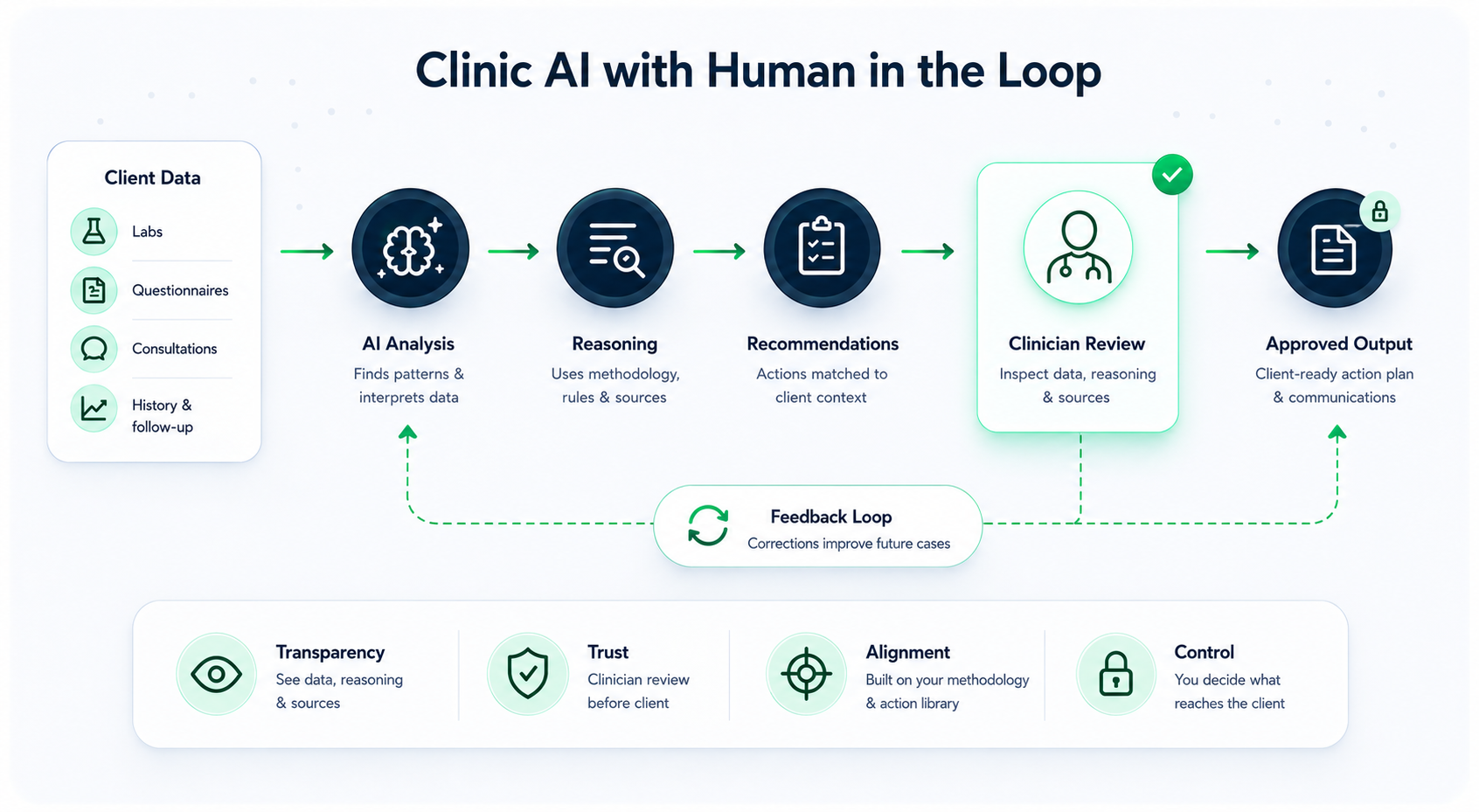
Elio explains that a clinician should be able to see:
- Which client data led to the recommendation
- What reasoning the system used
- Which sources support the recommendation and can be checked directly
That level of visibility is important in longevity care because recommendations are often based on patterns across biomarkers, questionnaires, consultations, and follow-up over time. These workflows rely on interpretation. The system needs to clearly support that review process.
Trust is lost when the output needs constant checking
Elio points to a problem that many clinicians may recognize. AI can produce hallucinated content, made-up references, small inaccuracies, or outputs that sound reasonable and still need verification. Once that happens, the team starts treating every AI output as something that needs checking line by line, as well as checking the credibility of the source.
That has direct consequences for workflow. The team spends time verifying instead of using the system with confidence. For clinic leaders, this is one of the signals to watch during evaluation. An AI system should reduce review burden. It should not create a new one.
Generic AI can add a burden on the clinic team
Generic AI tools can be hard to embed in routine care. The clinician has to gather the right client data, provide the right context, write the right prompt, and control which sources the model should use. On top of that, a general-purpose tool can miss relevant information if it does not retrieve the right files or if the prompt leaves out something important.
That means quality depends heavily on how much setup work the clinician does before the model even starts. For founders and CEOs, this is an important operational point. If consistency relies on manual prompting, results will vary from case to case and from user to user.
Context handling determines output quality
Large language models perform better when they receive the right context at the right stage. Once too much information is pushed into one interaction, output quality drops.
A clinic-ready system should structure the workflow in focused steps. Each task should receive the context relevant to that task. Interpretation, recommendation selection, and personalization each need their own logic and their own scope.
What a clinic-ready AI system should include
An AI system used in longevity care should:
- work from a defined action library created around the clinic's own methodology
- include clear selection logic for each action
- account for contraindications
- show which biomarkers or questionnaire answers informed a suggested action
- show the reasoning behind the personalized description presented to the clinician
This kind of structure gives the clinic a stable base for review. It keeps recommendations aligned with the clinic's own way of working. It also gives clinicians a more efficient starting point because they are reviewing suggestions inside a known framework.
The system should also include a feedback loop. When a clinician corrects a recommendation, that feedback can be saved and used in similar future cases. In this way, the system becomes more aligned over time instead of repeating the same avoidable mistakes.
Review belongs inside the workflow
AI-generated actions should be reviewed and approved by a clinician before the client sees them.
It gives the clinic a defined control point before any recommendation becomes client-facing. Review also needs the right supporting information around it. The clinician needs access to the source data, the selection logic, and the reasoning behind the recommendation in order to approve it responsibly.
This is one of the most useful evaluation criteria for longevity clinic founders. Review should be built into the system design.
What clinics are likely to expect next
Elio expects clinics to want more automatic updating of health insights and action plans when new data becomes available, including lab reports, questionnaires, or consultation outcomes. He also mentions stronger integration of new evidence into workflow, while noting that scientific quality varies and there is no single accepted source of truth that clinics can rely on automatically.
That is relevant for founders and CEOs because it shows where expectations are moving. Clinics will increasingly want systems that can support a more continuous workflow around changing client data.
Questions worth asking before adopting AI in longevity
If you are evaluating AI for your clinic, these questions are useful:
- Can clinicians see what data led to a recommendation?
- Can they inspect the reasoning behind it?
- Does the system follow the clinic's own methodology?
- Does every client-facing output go through approval?
- Does the data handling fit your compliance requirements?
- How much manual setup is still required from the clinical team?
These questions give clinic leaders a way to assess whether an AI system can support daily operations.
Where LongevOS fits
These principles are also what guided the design of LongevOS. It structures the process between client data and clinical action so that the team does not have to piece together context, check scattered inputs, or work through one long AI interaction. Clinics can review suggestions faster, work from their own methodology, and keep control over what reaches the client.
Curious to see how these principles work in practice? Take a closer look at LongevOS for longevity clinics.